Databases · distributed systems
Cassandra in practice: a 3-node cluster, a failure test and ten years of data
With two classmates, I explored how Cassandra copes with large amounts of data: we designed the schema around our queries, ran a 3-node cluster that kept answering with one node down, and compared it with PostgreSQL over ten years of simulated sensor data.
- Period
- October – November 2026
- Status
- Completed · group project (3 students)
- Type
- Academic project
The project
Coursework for the Information Systems course at ENSGMM (2026–2027), done by three of us and supervised by the lecturer. The topic: how wide-column databases handle large amounts of distributed data. We worked on a concrete case, a sensor network writing a reading every few seconds for years, where the database has to stay fast as history grows and survive losing a machine. We first showed how the model works on a real cluster, then measured where it wins and where it loses against a well-indexed relational database.
- Schema designed from six queries, giving four tables. Duplication is expected in this model.
- Partition key (sensor_id, day): day bucketing caps each partition at about 8,640 rows per sensor per day. A clustering key on the timestamp keeps time ranges fast.
- Three Cassandra 5.0 nodes in Docker with limited Java heap; keyspace with RF = 3, plus a test keyspace at RF = 1 to make partitioning visible.
- A Python benchmark script loads one year at a time (1.75 million rows each) into both Cassandra and PostgreSQL, then times the same queries.
What we did, and what went wrong
- Explained the model in the report: the Bigtable data model, Murmur3 partitioning, replication, tunable consistency, write and read paths, and a comparison with HBase and relational systems.
- Built the cluster and the IoT case study, and kept the real cqlsh and nodetool outputs as evidence.
- Ran the ten-year benchmark and a PostgreSQL → Cassandra migration with verification scripts.
- Wrote the report and the presentation in LaTeX.
What went wrong
- With RF = 3 on three nodes, every node holds 100 % of the data, so replication was visible but partitioning was not. A second keyspace at RF = 1 and nodetool getendpoints showed which node owns which sensor.
- One laptop cannot host the assignment's full data rate. We lowered the reading interval from 10 seconds to 15 minutes and said so, explaining how it changes the results.
How I checked it
What I wanted to prove, the test I ran, and what I actually saw.
| What I wanted to prove | The test | What I saw |
|---|---|---|
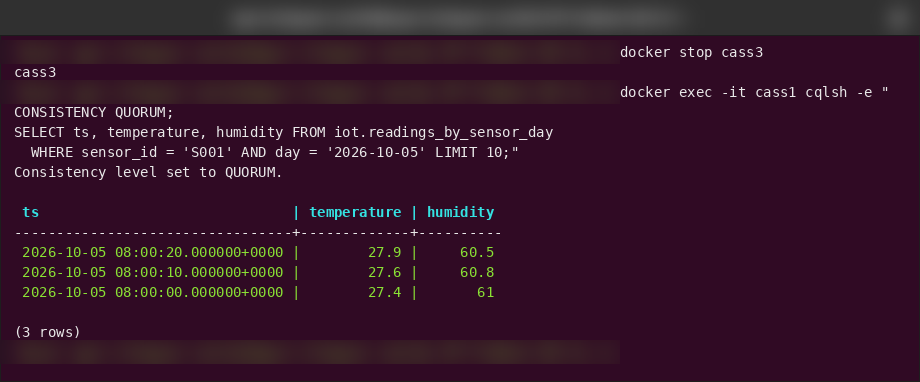
| The cluster survives one node down | docker stop cass3, then query Q1 again from cass1 at QUORUM | Query succeeded (two replicas of three still available) |
| Read time does not grow with history | Key lookups measured after each year loaded, 1 to 10 years | Cassandra flat at 3–5 ms; PostgreSQL 0.3–1.6 ms, slowly rising |
| Writes and storage favour Cassandra | Single-row write throughput; disk usage after 10 years | 2,504 vs 305 writes/s · 349 MB vs 1,755 MB |
| Unplanned questions are the weak point | Query outside the partition keys over 10 years | Cassandra timed out at 12 s (20.7 s when raised); PostgreSQL answered in 16–24 s |
Result
- A clear picture of the trade-off: Cassandra keeps planned queries fast whatever the history depth, writes and stores efficiently, but needs every question decided before the first write.
- Design lesson: in a wide-column database, modeling is about access paths as much as about data.
Limits and next steps
- All nodes on one machine: nothing is measured about scaling out, Cassandra's main advantage.
- Timings include the Python drivers and the Docker network.
- Group work: the report and code are shared by the three authors.
What I would do next
- Repeat the benchmark on several machines
- Measure at the original 10-second rate on a smaller time window
Code and documents
- Repository: report, CQL, benchmark, raw results github.com/AGRO-Rachidi/cassandra-wide-column-study